
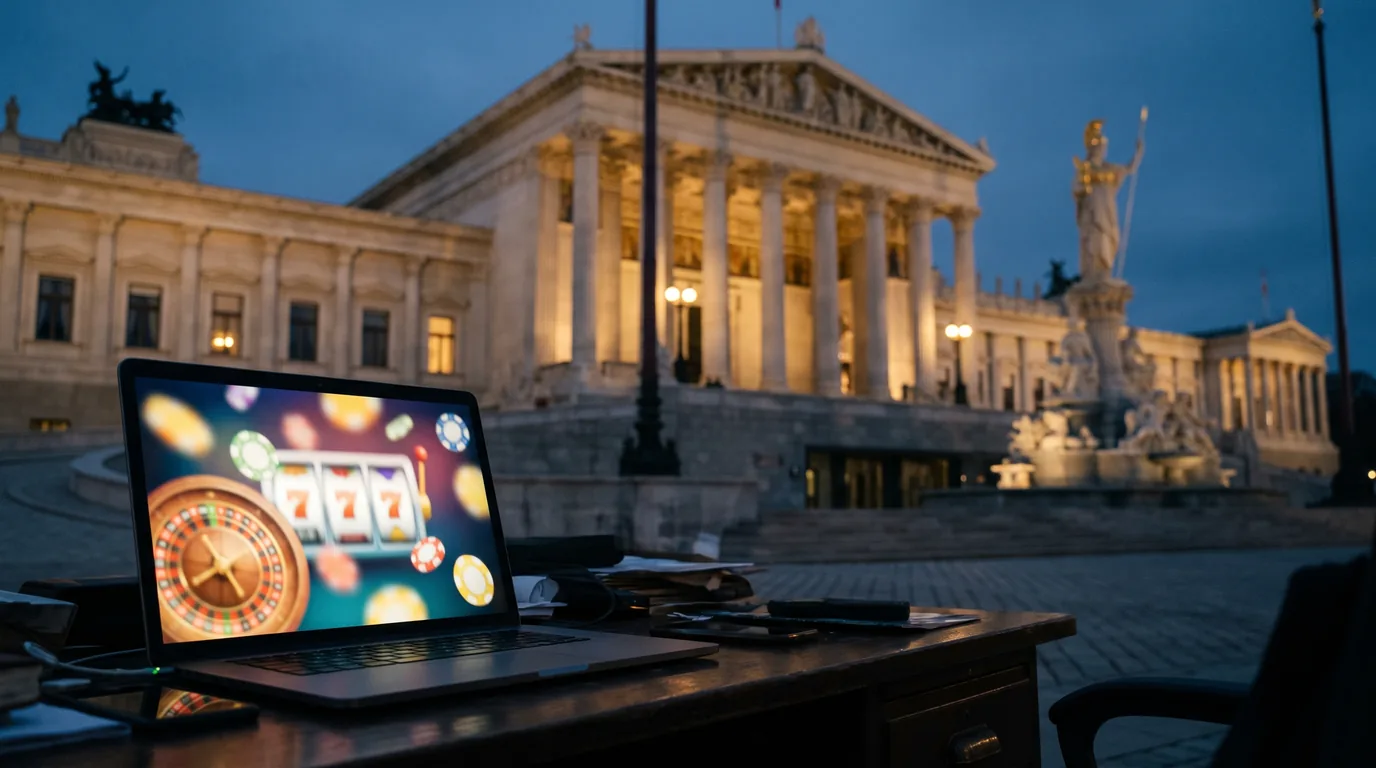
Austrian gambling law is facing its biggest change in 26 years. Since 5 August 2026, the government bill for the new Gambling Act has been before the National Council, and one day later it was referred to the Finance Committee. The vote is planned for the autumn. The current online monopoly of Österreichische Lotterien is to be replaced by a licensing system with several operators. Added to this are a central self-exclusion register, mandatory deposit limits, and network blocks and payment blocks against operators that appear in Austria without a licence.
For players who lost money at an online casino without an Austrian licence, a different point matters more than the market opening itself. It is found in § 14 of the draft and governs who can obtain a licence at all. Any applicant must have ceased its previous offering in Austria, must have paid outstanding gambling levies and must have satisfied all final judgments that participants obtained against it before Austrian courts. A judgment in the hands of a player would thereby become a hurdle for the operator’s licence.
This article describes what that means for pending proceedings, what applies to claims that nobody has asserted yet, and why 1 January 2027 plays a role of its own. It is based on the text of the government bill, the explanatory notes to it and the releases of Parliament and the Ministry of Finance. The law has not yet been passed, and individual points may still change during the parliamentary process. We are a litigation funder and not a law firm. What the draft means for an individual case is clarified by the lawyers cooperating with us; this article sets out what is in the text and what we observe from it in practice.
What the government bill provides for the online market
On the player protection side, the draft brings a central self-exclusion register that applies to all operators, as well as mandatory deposit limits, which are also meant to work across operators. Against the market without a licence, three tools are planned that did not previously exist in Austria. Network blocks are meant to block access to offerings without a licence. Payment blocks are meant to oblige banks to stop payments to such operators. Added to this are covert test plays by the tax administration. According to the parliamentary correspondence, the self-exclusion register, network blocks and payment blocks are to enter into force on 1 January 2027.
The timeline up to then looks like this:
- 29 June 2026: The draft goes out for consultation, and 109 statements are received.
- 4 August 2026: The Ministry of Finance submits the draft to the European Commission for notification, which starts a three-month standstill period during which the parliamentary process can continue.
- 5 August 2026: Government bill 594 d.B. is received by the National Council and referred to the Finance Committee.
- Autumn 2026: The vote in the National Council is planned.
- 1 January 2027: The self-exclusion register, network blocks and payment blocks are to take effect, and at the same time the period begins from which applicants must have ceased their previous offering.
- 2027: According to the parliamentary correspondence, the new online licences are to be grantable from January and to apply from October.
The paragraph that counts for those affected
The decisive text is in § 14 para. 2a of the draft. It lists three conditions that an applicant for an online licence must meet before its suitability is even assessed. First, all gambling levies that have fallen due so far and are not yet time-barred must have been paid. Second, and this is the sentence at issue here, the draft literally requires: “All final judgments for performance of domestic civil courts that were obtained in the past by participants against the licence applicant must have been satisfied.” Third, the operation of gambling for participants from Austria must have been ceased from 1 January 2027.
The explanatory notes to the government bill give a brief reason for the second condition: the provision ensures that final judgments of Austrian courts must be satisfied before a licence can be granted. In its press release of 4 August 2026, the Ministry of Finance links this condition to around 20,000 harmed players in Austria.
To understand why this is news, it helps to look at the situation of recent years. Austrian courts have awarded players their losses with operators without a licence in a great many proceedings, because under this case law the gaming contract without a licence is void. The problem rarely lay in the judgment, but in its enforcement. Operators based in Malta were able to hide behind a law of their own that instructs Maltese courts not to enforce such judgments. Anyone holding a final judgment had, in many cases, a piece of paper and no payment. The draft turns this logic around. An operator that wants to appear legally in Austria after 2027 could, under this text, no longer sit out its open judgments. Every unsatisfied judgment would bar its way to a licence.
Why the negotiating position is shifting
In our assessment, this condition is changing the behaviour of those operators that intend to apply for a licence even before the law is passed. Anyone who wants to stand before the authority in 2027 with a clean record has an interest in settling open claims beforehand, and in a form that lasts. As early as the beginning of summer, we observed in ongoing discussions that some operators have become more open to settlements than they were a year ago. Only the respective operator knows the precise motives, but the timing in relation to the legislative project is hard to overlook.
Two qualifications belong to this picture. First, the draft provides no legal entitlement to a licence, and not every operator will apply. Pure crypto casinos and operators that never regarded Austria as a core market will probably not take this route at all. For claims against such operators, the previous route via lawsuit and enforcement remains, with all the hurdles we described in our article on online casinos that are practically impossible to sue. Second, the draft speaks of final judgments. A claim that nobody has ever asserted is on no list and blocks no licence. The condition would only work for those who actually pursue their claim.
“A final judgment against an online casino has so far often been the beginning of the test of patience, not its end. If that judgment in future decides whether the operator may carry on in Austria, then that fundamentally changes the atmosphere at the negotiating table,” says Ing. Ronald Mechtler, BA, MBA, managing director of R. M. Prozessfinanzierung GmbH.
A warning also follows from this shift. An operator that wants to clean up its list of open claims before applying has an interest in doing so as cheaply as possible. Lump-sum settlement offers, collective settlements and offers to purchase claims far below their value could become more frequent in the coming months, not less. Anyone who receives such an offer should have it reviewed before signing. Why such offers are generally well below what proceedings achieve is set out in detail in our article on lump-sum offers for casino claims.
The 1 January 2027 deadline and what it triggers in practice
The third condition in § 14 para. 2a has a consequence that has received little attention so far. An operator that wants to apply must have ceased its offering for participants from Austria from 1 January 2027. Anyone who ceases later is subject to a waiting period: 18 months from cessation, and 24 months if cessation only takes place after 31 December 2029. In the explanatory notes, the legislator calls this period the cooling-off period.
For those affected, this means in practice that operators aiming for a licence will close or block the player accounts of Austrian customers at the turn of the year. In parallel, network blocks are meant to block access to offerings without a licence.
Very few of those affected know from memory how much they actually lost, and in our experience the true figure is almost always above the amount someone would name without documentation.
What the draft leaves unchanged in the starting position
In our understanding, the market opening changes nothing about the basis on which those affected reclaim their losses. Gaming contracts with an operator without an Austrian licence are void under the case law of the Austrian courts, and the losses can be reclaimed. On 16 April 2026, in Case C-440/23, the Court of Justice of the European Union confirmed that this reclaim is compatible with EU law, even where the operator holds a licence from another EU member state. What the judgment means in detail is set out in our article on the CJEU judgment C-440/23. Under the case law to date, claims arising from void gaming contracts only become time-barred after 30 years.
Nor do we read from the draft that a future licence would have retroactive effect. Anyone who lost money in 2019, in 2023 or this year with an operator without an Austrian licence lost it with an operator without a licence. That does not change if this operator receives a licence in 2027. The licence would permit the offering from the day it takes effect. Whether and how this affects a specific case is examined by the lawyers cooperating with us on a case-by-case basis.
On the enforcement side, too, things have moved independently of the law, which we report here purely as observers. On 15 January 2026, in Case C-77/24, the Court of Justice of the European Union ruled that players bringing claims against the managing directors of a foreign operator without a licence may in principle rely on the law of their state of residence, because that is where the damage occurs. On 19 February 2026, under case number 9 Ob 8/26f, the Austrian Supreme Court (OGH) then confirmed the jurisdiction of Austrian courts for such a claim against the managing director of an operator based in Malta. In doing so, it held that personal liability of company officers for culpable breaches of player protection rules under § 1311 of the Austrian Civil Code (ABGB) is possible in principle. The claim itself has not yet been decided in these proceedings. As regards the Maltese block on enforcement, known as Bill 55, the judgment of the Court of Justice of the European Union is still pending, and in April 2026 the Advocate General classified it as incompatible with EU law. We summarise the state of play in our article on Bill 55.
What a reclaim means if it succeeds
A fictitious, deliberately round example shows how an amount recovered is divided. A player lost 20,000 euros with an operator without an Austrian licence. If the claim is enforced in full, the reclaim amounts to 20,000 euros. Of this, 7,000 euros go to the success fee of R. M. Prozessfinanzierung of 35 percent, and 13,000 euros are paid out to the player.
The review is free of charge, we conduct the lawsuit at our own expense, and no advance on lawyers’ fees is payable. A fee is payable only in the event of success. How high a payout turns out in an individual case depends on the course of the proceedings, and the example is an illustration rather than an assurance.
Reclaim your losses now
The draft is before Parliament, the deadline is in the text, and operators that want a licence are, from what we observe, already beginning to sort out their open claims. Anyone who lost money at an online casino without an Austrian licence should have their case reviewed in the months before the turn of the year, not after it. Especially if you recognise one of the following situations:
- You lost money at an online casino without an Austrian licence, whether years ago or only recently, and have done nothing about it so far.
- You already hold a judgment against an operator that the operator has not satisfied.
- You have received a settlement offer, a collective settlement or an offer to purchase your claim that is supposed to be signed quickly.
- Your player account has been closed, or you fear you will no longer be able to obtain your deposit and withdrawal records after the turn of the year.
- You do not know how much you actually lost and would like to find out on the basis of the complete records.
“The legislator is making the satisfaction of player judgments the entry ticket to the legal market. But that entry ticket only exists for claims that are actually pursued. Anyone who never has their case reviewed is on no list,” says Ing. Ronald Mechtler, BA, MBA.
Reclaim your losses now. Send us a short message or give us a call, and we will review your case free of charge and tell you frankly whether and how it can be pursued: Reclaim your losses now.
Sources
- Austrian Parliament, government bill 594 d.B., amendment of the Gambling Act and the Telecommunications Act 2021 (received 5 August 2026)
- Parliamentary correspondence no. 787 of 12 August 2026, new in the Finance Committee
- Federal Ministry of Finance, press release of 4 August 2026, Ministry of Finance takes the next step towards the new Gambling Act
- CJEU, judgment of 16 April 2026, Case C-440/23 · Court of Justice of the European Union (CJEU) · C-440/23
- CJEU, judgment of 15 January 2026, Case C-77/24 · Court of Justice of the European Union (CJEU) · C-77/24
- Austrian Supreme Court (OGH), decision of 19 February 2026, 9 Ob 8/26f, available in the Austrian Legal Information System (RIS) · Austrian Supreme Court (OGH) · 9 Ob 8/26f